
We own the space between HR policy and manager behavior when it comes to parental leave.
Most HR leaders can name the resignation they didn't see coming, the manager who handled a disclosure badly, the employee who came back from leave and quietly checked out. What they can't always name is why it keeps happening, so they treat the symptoms. These aren't separate problems, they're the same gap, with the same root cause.
Organizations have invested in parental leave policy but never built a manager standard for how to execute it, so every manager handles it differently based on their own experience, instincts, and whatever they happen to know in that moment.
The Protected Leave gives your managers a defined process for what to do at the points where risk and attrition occur in the leave lifecycle, so outcomes do not depend on which manager an employee has.
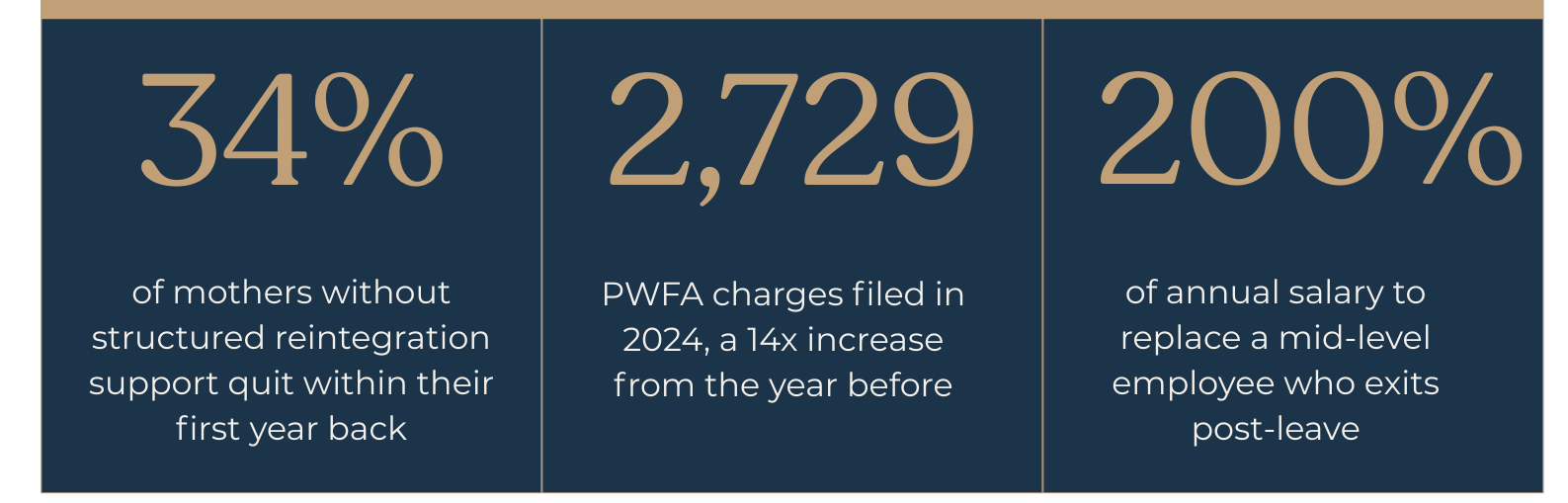
Legal exposure is one reason to act. The other is simpler, parental leave is one of the most visible commitments a company makes to working parents. How it goes in practice shapes whether your best people stay.
Sources: SHRM, EEOC Annual Report, US Dept of Labor
The problem isn't always your policy. It's that no one owns the space between what HR designed and what managers actually do.
How We Work
Structured execution for every phase of the leave lifecycle.
All engagements are facilitator-led manager cohort sessions. There’s no new platform or software to learn. Managers leave with physical toolkit materials they can actually use.
The Departure Protocol
Disclosure through active leave
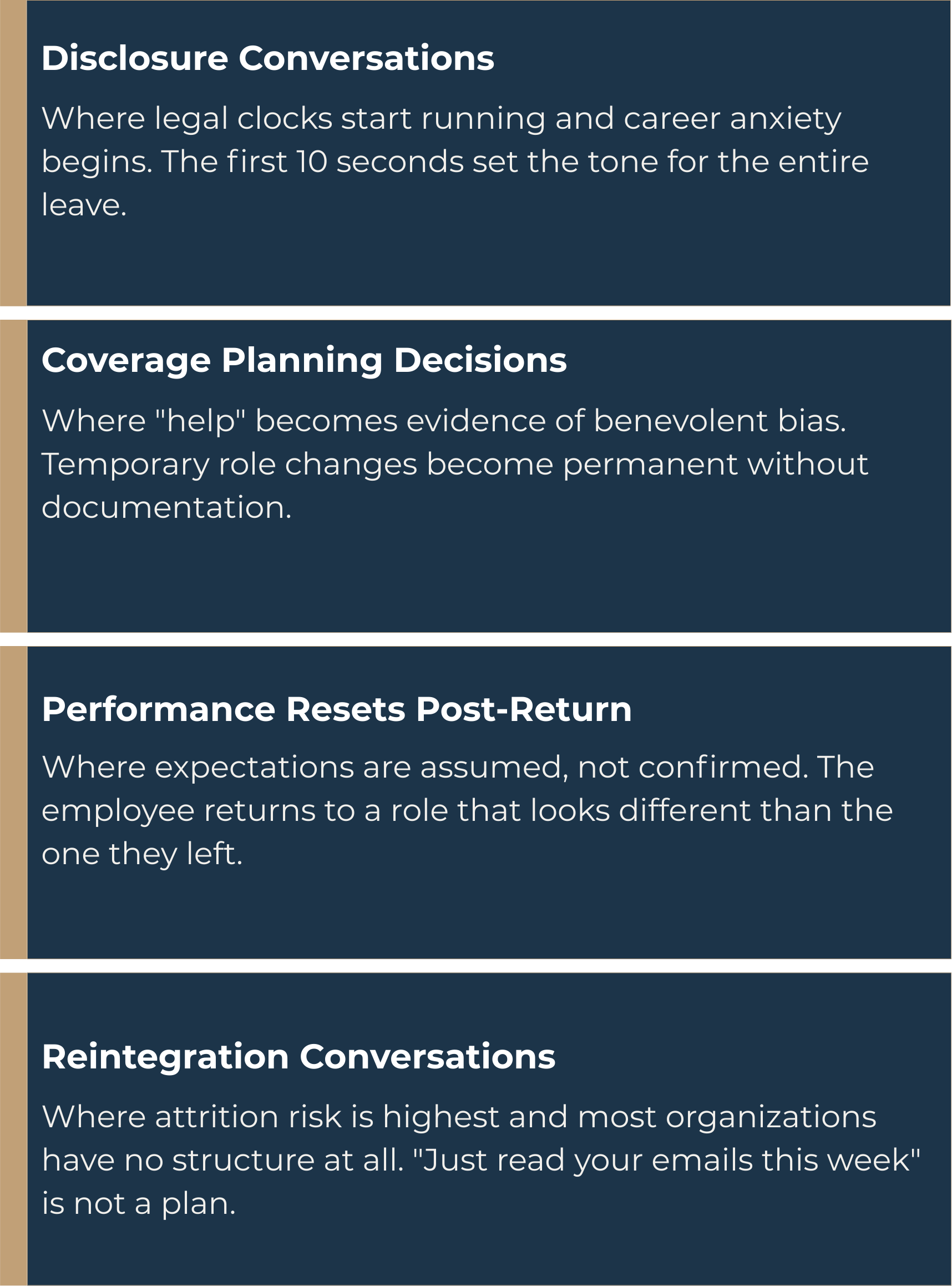
By the time HR finds out something went wrong after a disclosure conversation, it's usually too late to undo it. The accommodation request wasn't handled correctly, the role quietly changed without documentation, and the manager reached out during leave because there was no operational plan to prevent it. None of it felt like a problem at the time. All of it becomes one later. This session gives managers a structured process for handling disclosure correctly from the first conversation through active leave, including the compliance requirements triggered at disclosure, strategies for managing operational challenges while someone is out, and the planning tools they need to protect the employee's role before leave begins.
What this includes
A structured response protocol for the disclosure conversation, including the compliance requirements triggered the moment an employee discloses
A three-question diagnostic tool for resolving operational challenges during active leave before they become a problem for the organization.
A structured handoff framework and planning tools that document the transition and protect the employee's role.
01
Start here
60 to 90 minute cohort session. Includes scripts and templates.
The Re-entry Protocol
Return through 90 days post-return
Most parental leave attrition doesn't happen during leave. It happens in the first 90 days after someone comes back. The manager says "just read your emails this week" without an actual plan. The employee comes back underwater and nobody notices until performance starts slipping. This session gives managers a structured 90-day framework for bringing someone back, including a clear plan for day one, defined checkpoints through the first three months, and decision tools for handling performance concerns if they arise.
What this includes
A day one return conversation structure that sets the tone for the full re-entry period. A 30-60-90 reintegration framework with defined checkpoints that catch support needs early, before they turn into performance issues.
A decision framework for distinguishing normal re-entry adjustment from a genuine performance concern.
A timing and documentation framework for addressing performance concerns post-return in a way that reduces organizational risk.
02
RE-ENTRY
60 to 90 minute cohort session. Includes scripts and decision tools.
The Manager Execution Standard
All phases with accountability layers
Right now, parental leave outcomes depend almost entirely on which manager someone has, and the ones who cause the most damage usually don't recognize it as damage. That's not a hiring problem or a culture problem. It's a standards problem, and it's solvable. This engagement covers the full leave lifecycle with a single cohort, giving your manager population a consistent process from disclosure through 90 days post-return, with the planning tools and documentation that make execution verifiable, not just encouraged.
What this includes
Phase-based manager training across the full leave lifecycle
The full lifecycle curriculum (The Disclosure Protocol + The Re-entry Protocol) delivered to a single cohort, covering disclosure through 90 days post-return, with the planning tools, decision tools, and documentation structure that create a consistent and defensible standard across your entire manager population.
03
FLAGSHIP
Two-session flagship engagement. Includes full toolkit and 30-day checkpoints.
When parental leave goes well, HR should get credit for it.
What HR can prove
Right now, when a leave transition goes smoothly, there's no paper trail that says HR built something that made that happen. When it goes badly, HR gets the escalation. This system changes that. Every engagement builds a documented, trackable record HR can report upward.
Manager protocol completion rate
HR escalations related to leave
90-day post-return retention of leave-takers
What we measure together at 90 days
Explore The Protected Leave™
free diagnostic tool
Not sure where your gaps are?
Take the free 10-point Parental Leave Risk Assessment. Two minutes and you get an instant score. Most HR leaders land in the “open gap” tier, which means the gaps are real but fixable.
See exactly where your risk exposure lives
Benchmark your manager readiness against what actually prevents resignations
Get a personalized risk score you can share with your leadership team
Get your Parental Leave Risk Assessment Score
Takes 3-5 minutes
common questions
What HR Leaders Want to Know
-
No, and that is intentional. I am a former people manager with nearly a decade of experience leading teams through parental leave transitions in an organization where I also went on leave myself. I build operational systems that prevent the manager behaviors that create compliance problems. I teach what works at the manager level in real conversations, not just what the law says in theory.
For specific legal questions about your organization’s obligations under PWFA, the PUMP Act, FMLA, or state laws, I will always refer you to qualified employment counsel. My role is to reduce the situations that require that conversation in the first place.
Nothing in The Protected Leave™ materials, training sessions, or assessments constitutes legal advice. Organizations should consult qualified employment counsel for guidance specific to their circumstances.
-
HR designs policy and ensures compliance at the organizational level. Managers make the day to day execution decisions.
Most organizations assume managers know how to handle leave transitions because policies exist. In practice, many managers are navigating these conversations for the first time. This training supports HR by giving managers structure so HR is not pulled in after a problem has already escalated.
-
Engagements are cohort based and interactive. Sessions are delivered live, virtually or in person, depending on your needs. Modules typically range from 45 to 90 minutes and include practical application, discussion, and scenario work so managers can practice the frameworks rather than passively receive information.
Cohort size is intentionally limited to preserve discussion quality and ensure managers can apply what they learn.
-
Strong policies still require strong execution.
We do not rewrite your policies. We build the operational layer that helps managers carry them out consistently. The gap between what is written and what happens in a manager’s first conversation is where resignations, complaints, and performance disruption often begin. That is the gap we address.
-
Even a small number of transitions can have outsized impact.
If one return goes poorly, the cost of replacement, disruption, and lost productivity can exceed the investment in building a consistent framework. The systems developed in this training also apply to other protected leave events, not just parental leave, which increases the return over time.
-
Most compliance training focuses on awareness. Managers learn what not to say and what laws apply.
This training focuses on execution. Managers receive specific scripts, structured frameworks, and decision tools for disclosure, leave management, reintegration, and post leave performance calibration. The difference is not knowledge, but operational structure.
-
The frameworks are consistent, but the examples, toolkit language, benefit mapping, and manager tools are tailored to your organization. Managers receive materials aligned to your policies, your benefits structure, and your operating reality rather than generic scenarios.
-
This engagement is most impactful in organizations where managers independently oversee performance and workload decisions and where parental or protected leave events occur regularly enough to require consistent handling.
It is particularly valuable in mid sized and enterprise environments where inconsistent execution across departments creates uneven employee experiences.
-
Organizations typically see:
More consistent disclosure conversations
Fewer informal arrangements during leave
Structured and documented re entry plans
Reduced post leave attrition
Fewer reactive escalations to HR
Stronger documentation practices during the first 90 days post return
The goal is not simply compliance awareness. It is consistent execution.